OpenFactory Overview#
OpenFactory is a modular, software framework designed to support the development and operation of data-centric, event-driven industrial systems. It provides a scalable, real-time infrastructure for monitoring, analyzing, and controlling industrial assets through a distributed, fault-tolerant streaming architecture. Grounded in the principles of Industry 4.0, OpenFactory enables the virtualization of physical assets and their orchestration via a data stream-based control loop.
Architectural Foundations#
OpenFactory is organized around a Kappa architecture, in which data flows unidirectionally from sources (industrial assets) into a persistent stream processing layer, and actions can be emitted downstream to influence those same assets.
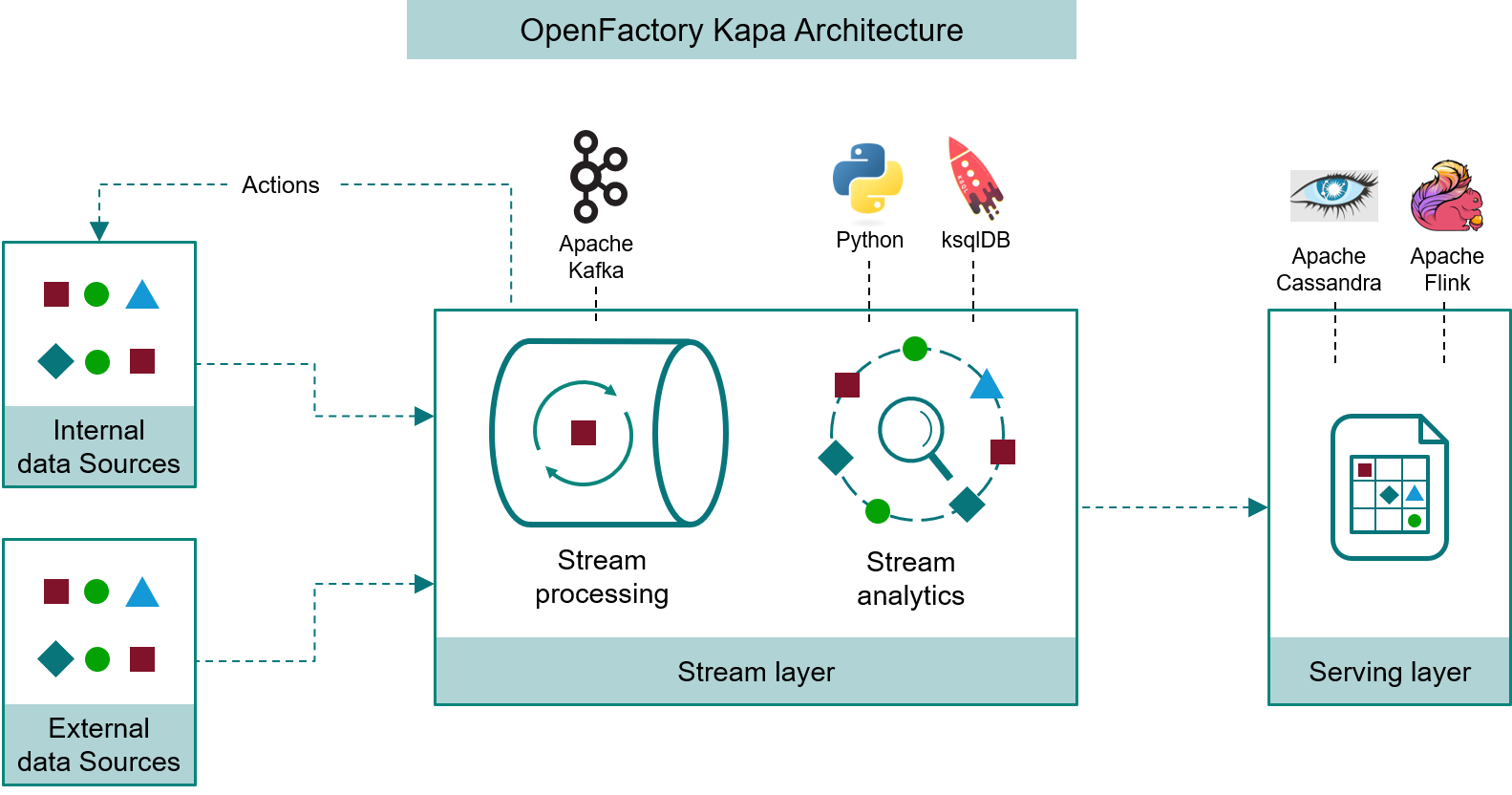
The system supports hybrid deployment modes, operating across on-premise edge systems and cloud environments, with elasticity, fault tolerance, and high throughput.
To fully implement this architecture, OpenFactory relies on the following core building blocks:
1. The Factory (Physical Layer)#
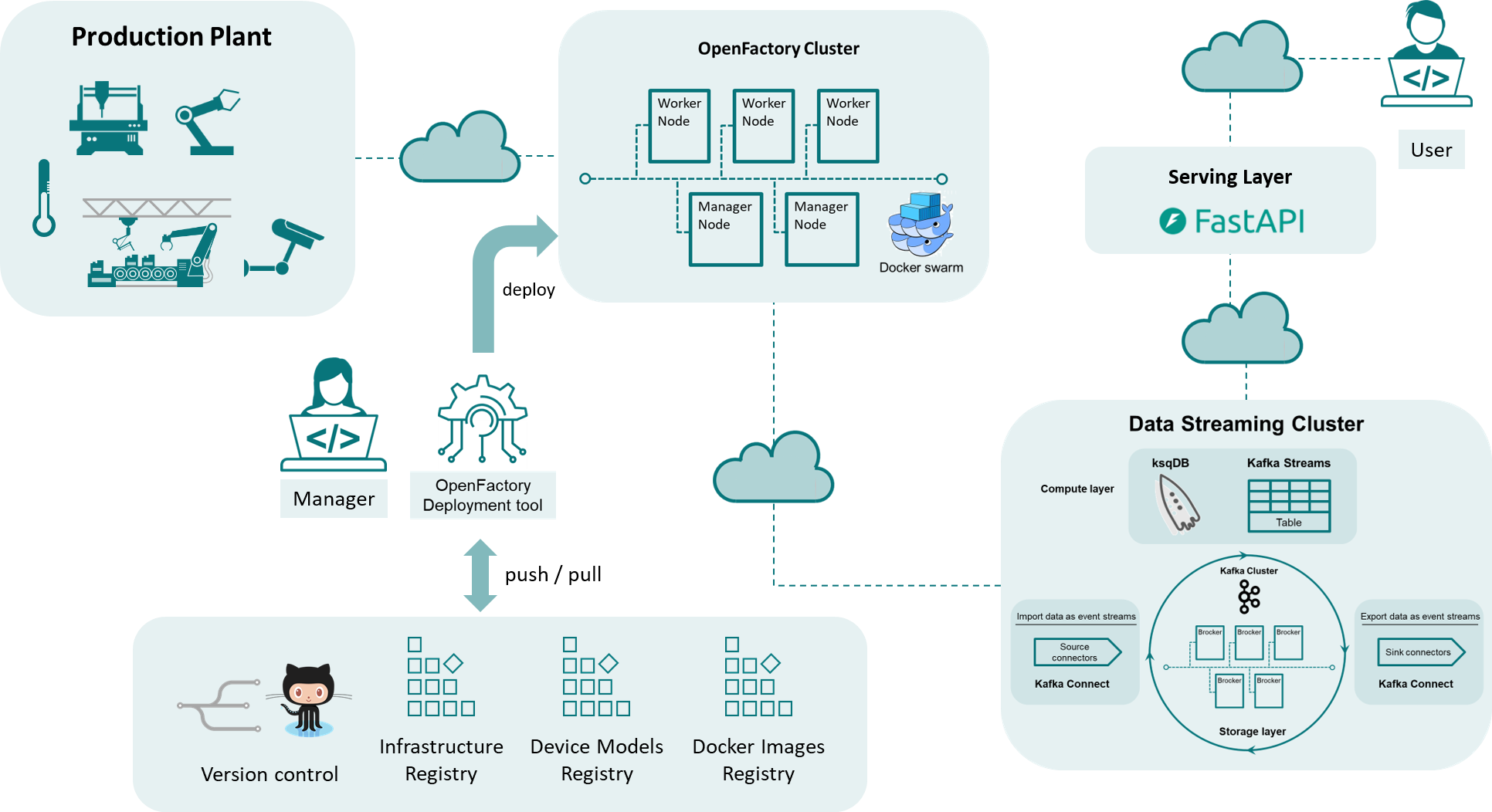
At the lowest layer are the physical assets, such as machines, sensors, actuators, and industrial controllers. These assets are considered data producers and consumers, capable of both emitting real-time telemetry and receiving control commands.
Each asset is semantically modeled following closley exisitng standards (MTConnect, RAMI4.0) and virtualized into the system through specialized connectors, which translate between industrial protocols (e.g., OPC UA, Modbus, MTConnect) and the OpenFactory data model.
2. The OpenFactory Cluster (Service and Orchestration Layer)#
This layer hosts the microservices that interface with physical assets, perform stream processing, and serve user applications. The cluster is managed using Docker Swarm, enabling resilient and distributed deployments across heterogeneous compute environments.
Microservices deployed in the OpenFactory cluster include:
Connectors to ingest data from assets and send actions back
Stream processors (Python or ksqlDB-based)
Serving applications such as dashboards, APIs, or alerts
The cluster acts as a programmable runtime where service composition, deployment, and scaling are fully automated and driven by version-controlled configuration files.
3. The Kafka Cluster (Streaming Backbone)#
The Kafka cluster is the central data plane of OpenFactory. It provides:
Persistent and ordered streams of events from industrial assets
Topic-based routing of data across the system
High throughput and low latency, supporting real-time processing at scale
Stream processing is performed through:
ksqlDB: a SQL-like engine for declarative stream analytics (e.g., filtering, aggregation, enrichment)
Custom Python services for advanced logic (e.g., anomaly detection, machine learning inference)
All asset interactions—both data ingestion and control signals—pass through Kafka topics, enabling complete observability and replayability of asset behavior.
4. The Repositories (Infrastructure and Knowledge Layer)#
OpenFactory emphasizes Infrastructure as Code (IaC) and Versioned Asset Models. This layer includes:
Configuration repositories, defining service deployment, Kafka topics, and ksqlDB queries
Asset model repositories, encoding metadata, identifiers, and behavioral models of each physical asset
Docker image registries, storing containerized versions of OpenFactory services and connectors
By externalizing all definitions into version-controlled repositories (e.g., Git), OpenFactory enables consistent deployments, rollback capabilities, CI/CD pipelines, and collaborative development across teams.
5. External Users and Applications (Serving Layer)#
External stakeholders—such as operators, engineers, analysts, or third-party applications—interact with OpenFactory through the serving layer of the Kappa architecture. This includes:
User-facing services (e.g., dashboards, REST APIs)
Streaming APIs (e.g., WebSocket or Server-Sent Events endpoints)
Data export tools (e.g., time-series databases, external BI systems)
The serving layer provides access to both raw and processed data, enabling integration with enterprise systems (e.g., ERP, MES), and supports the development of data-driven decision-making tools such as predictive maintenance systems or adaptive process controllers.